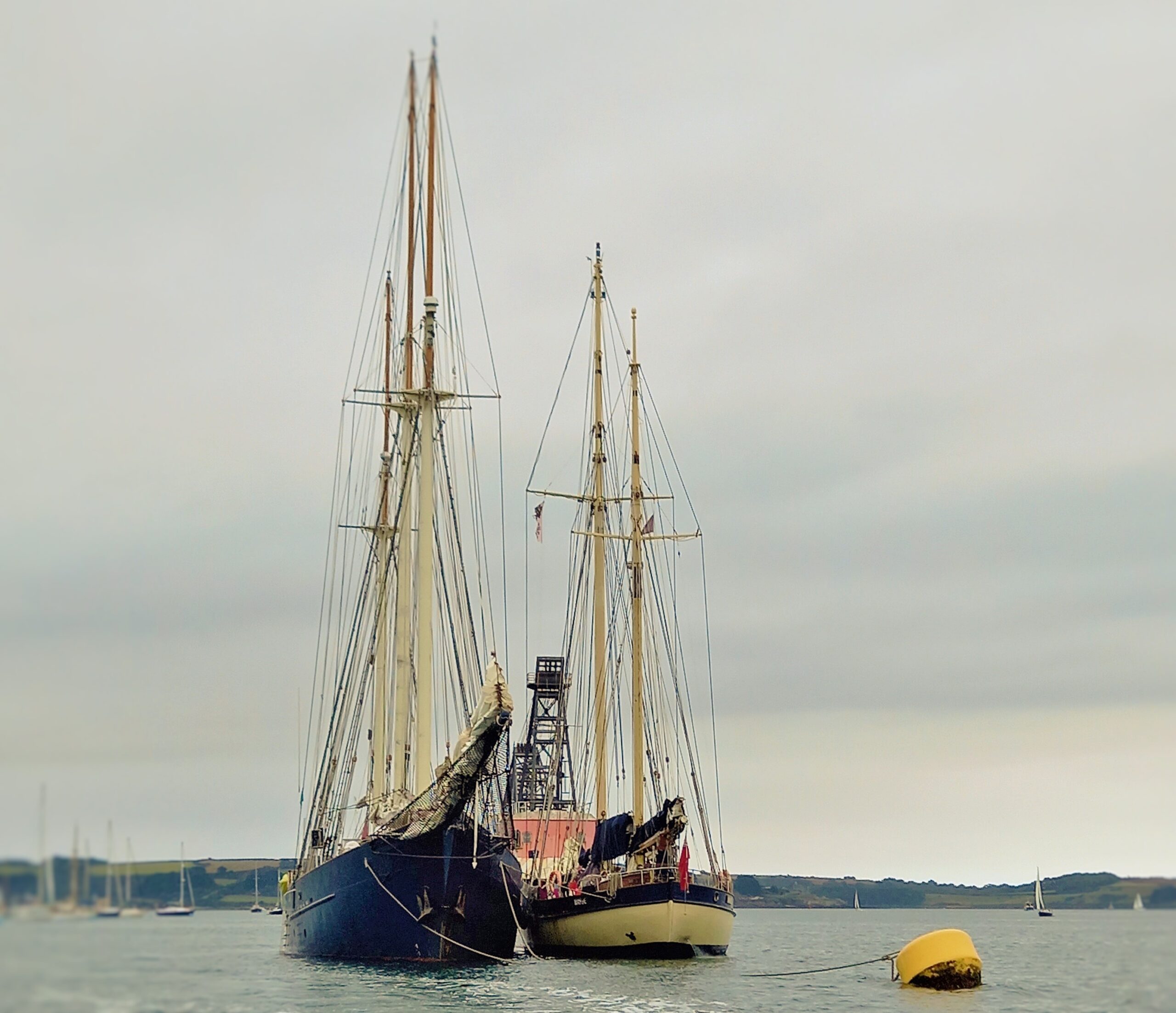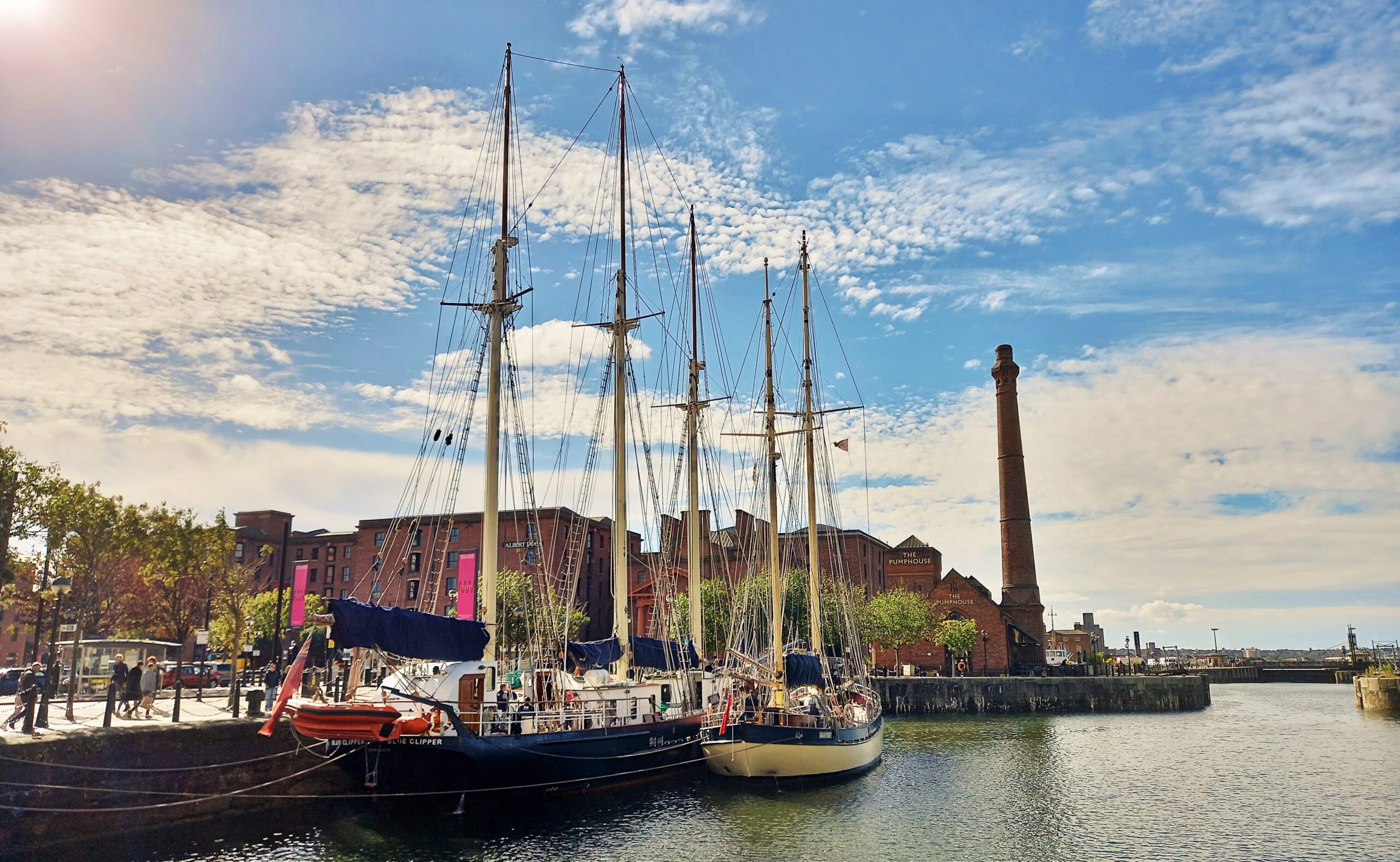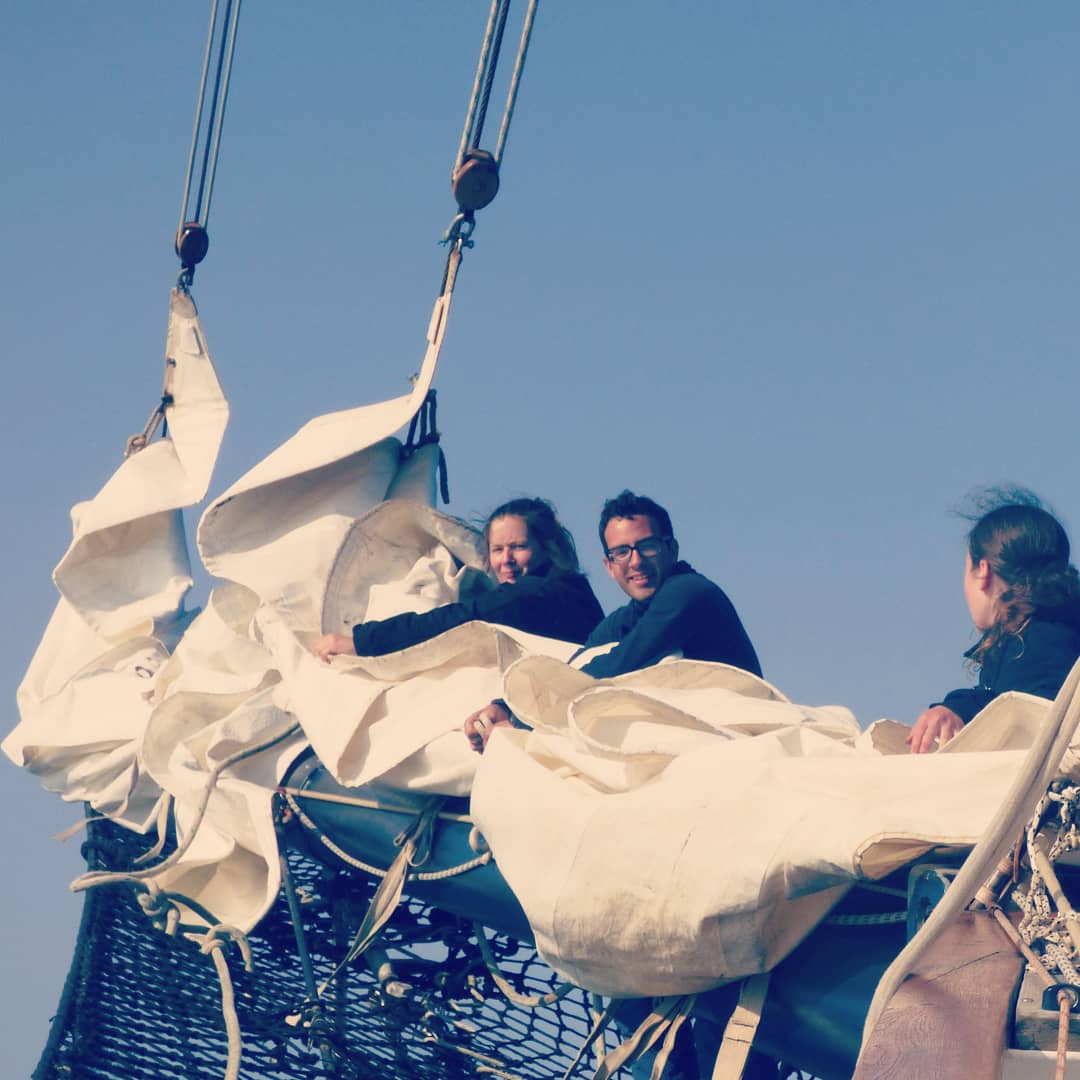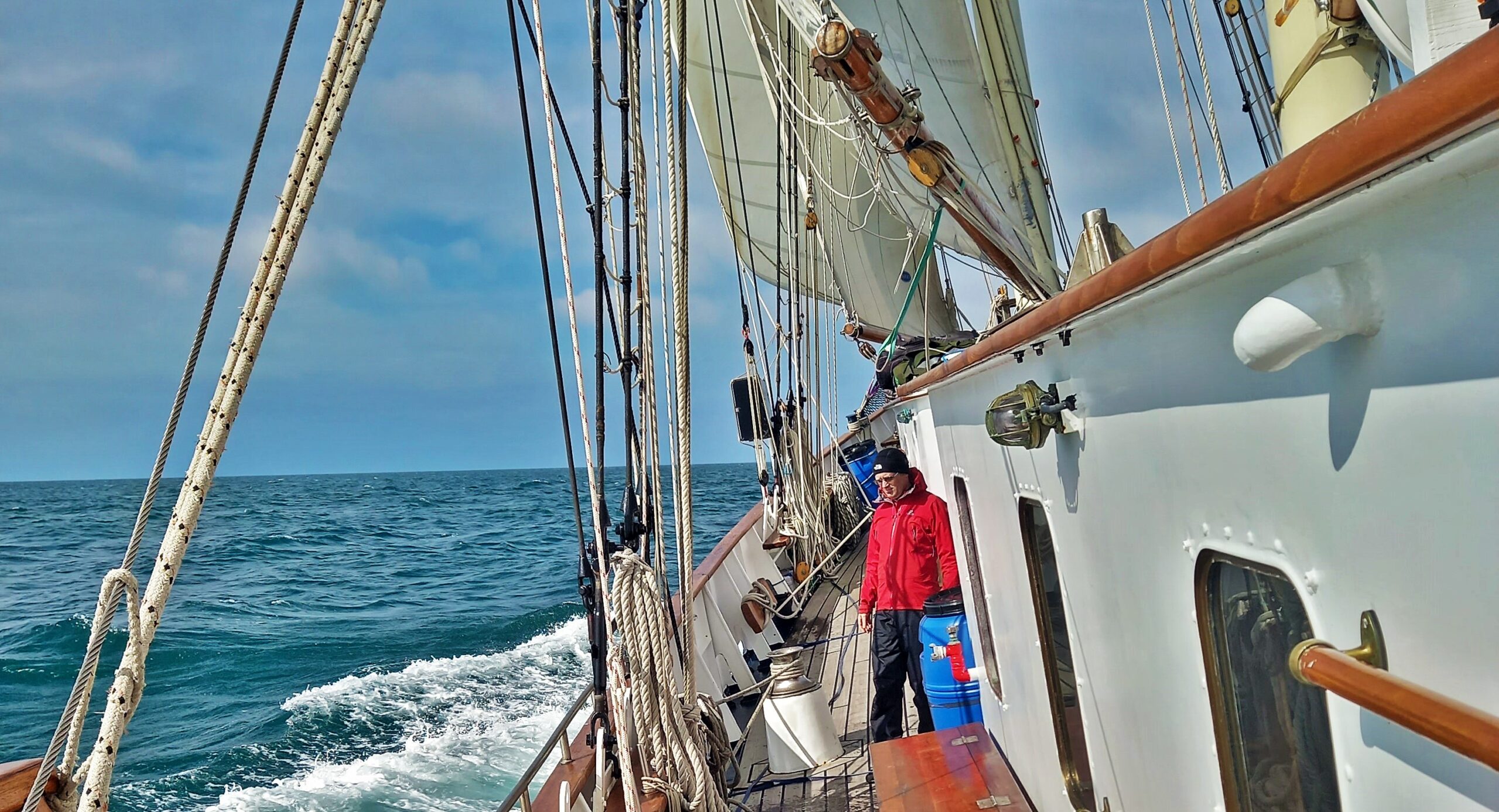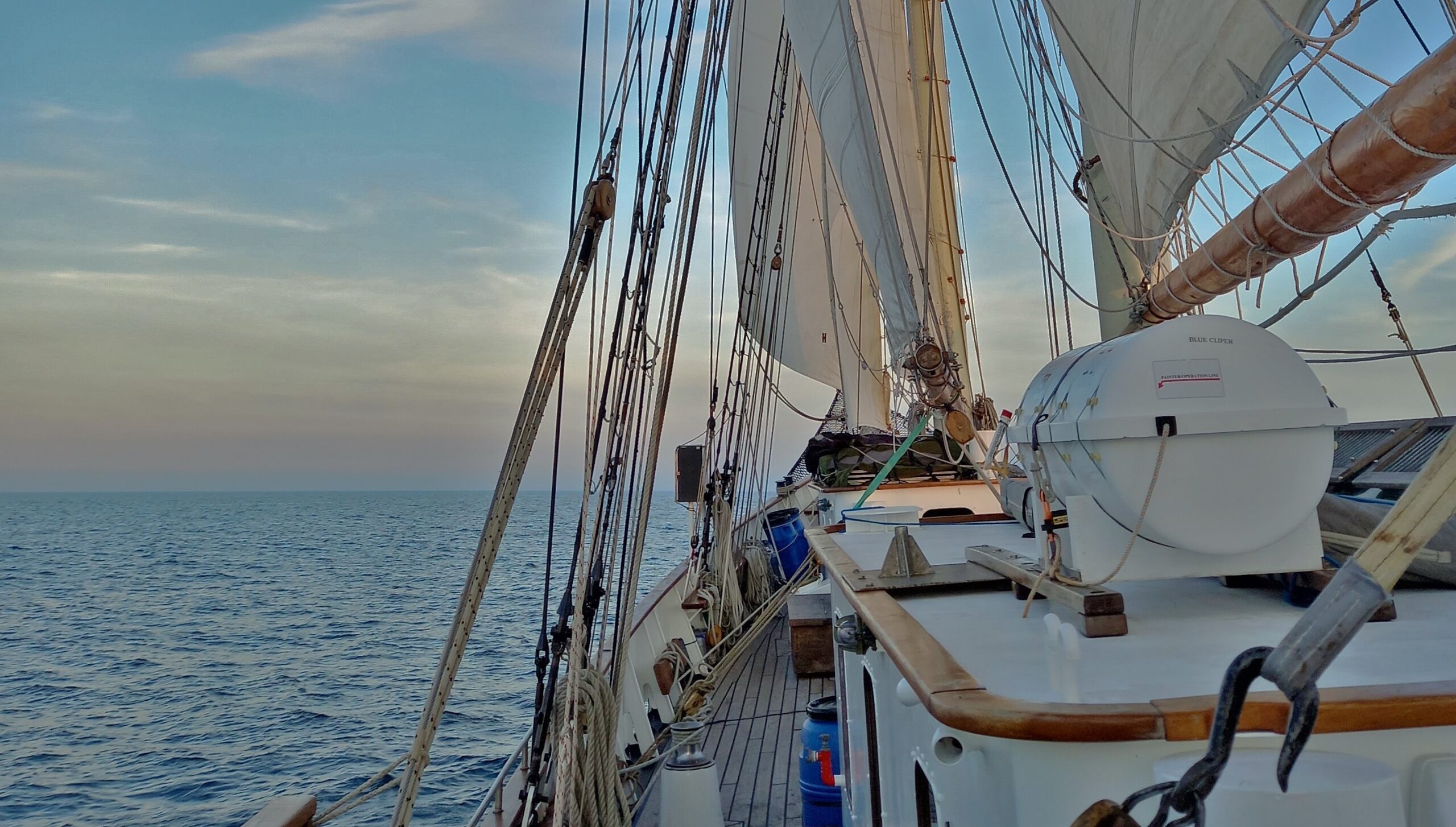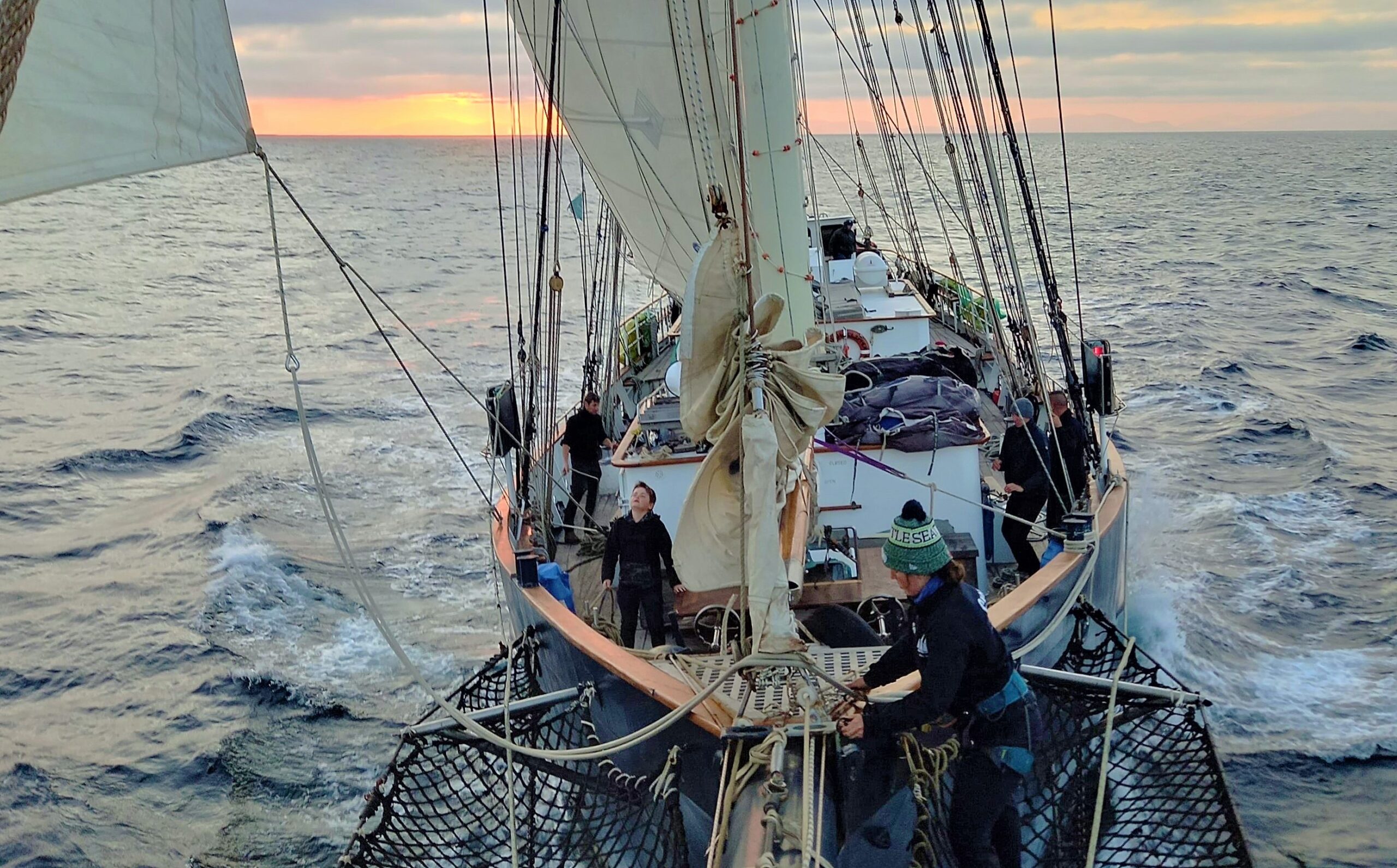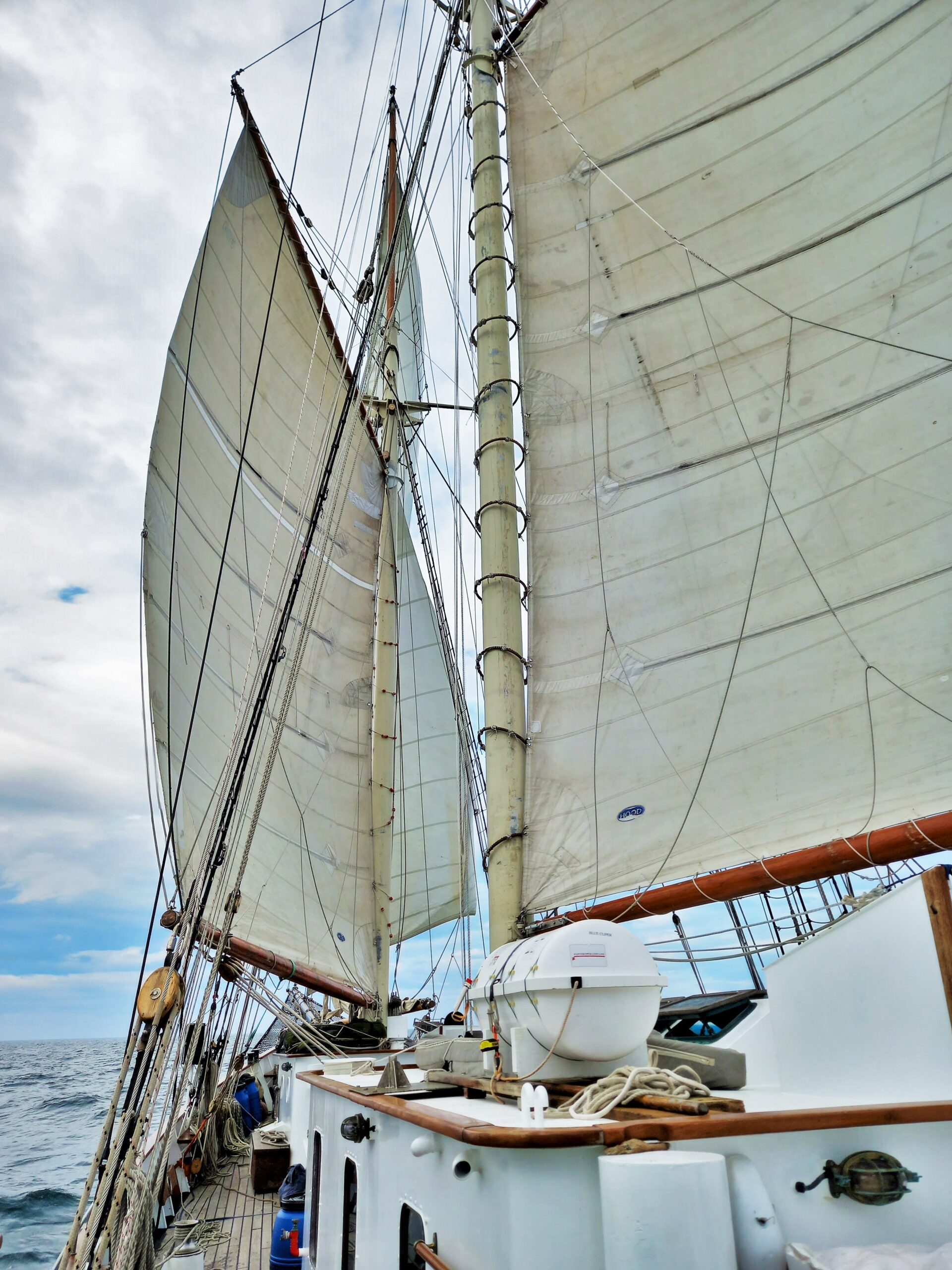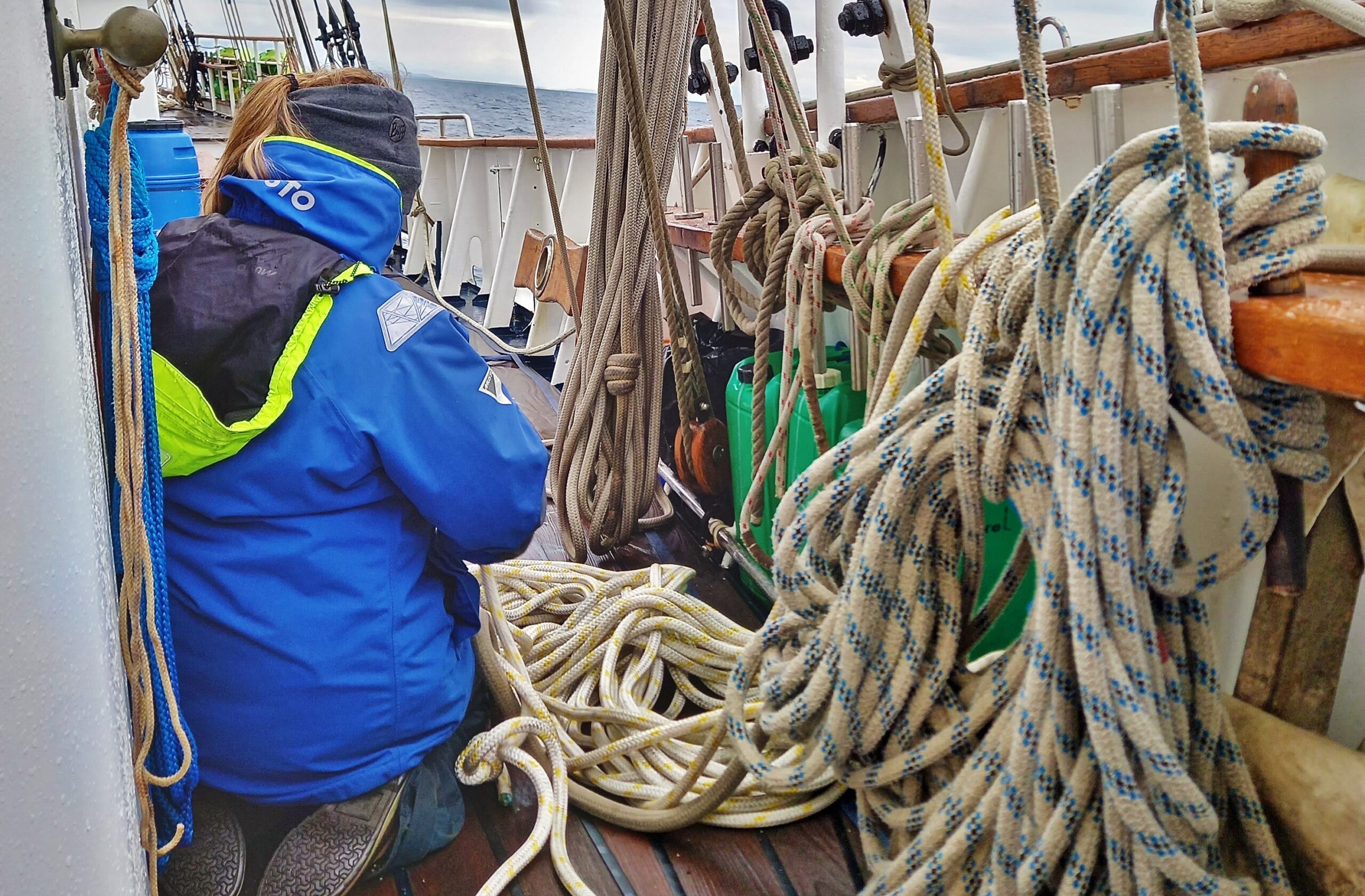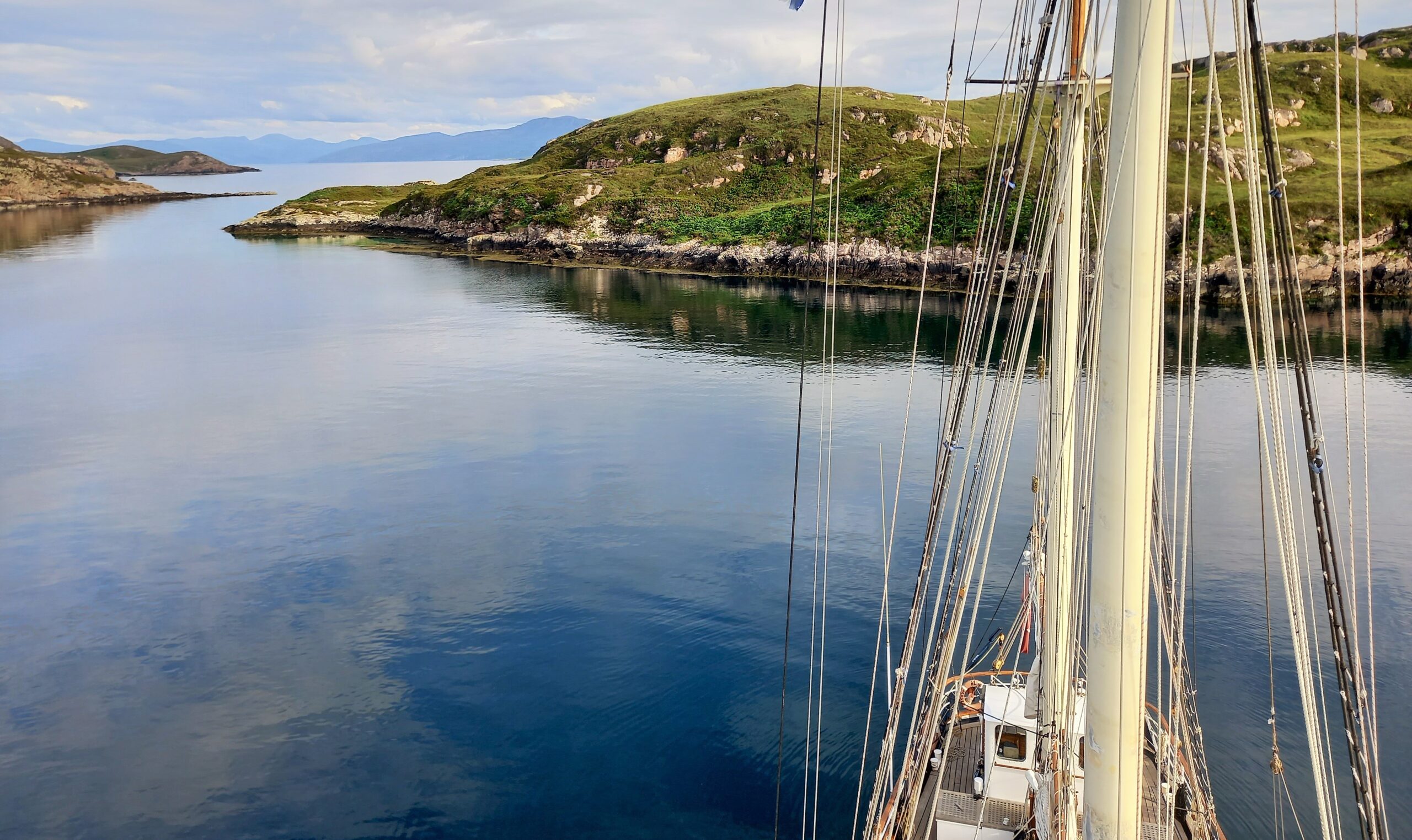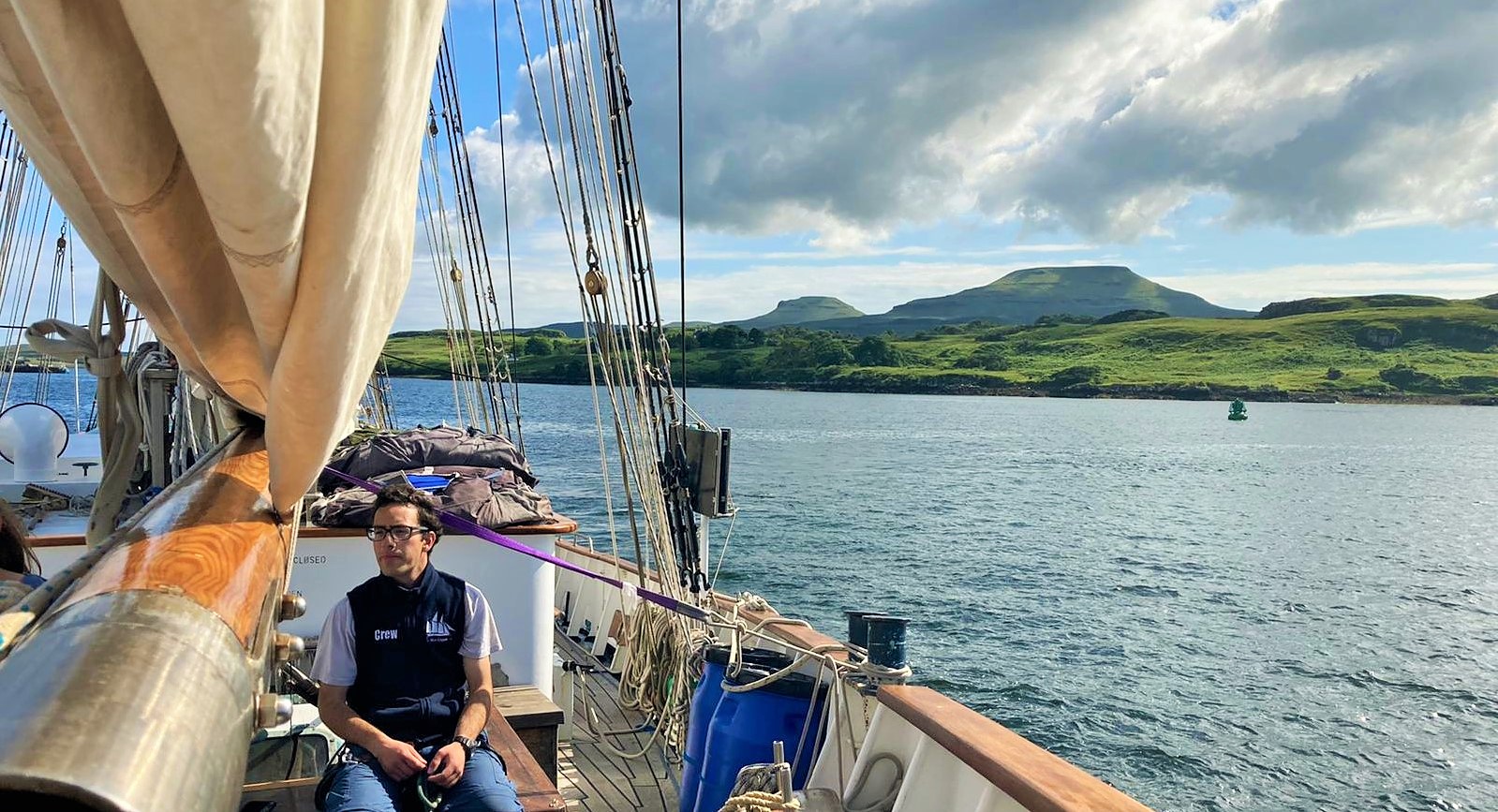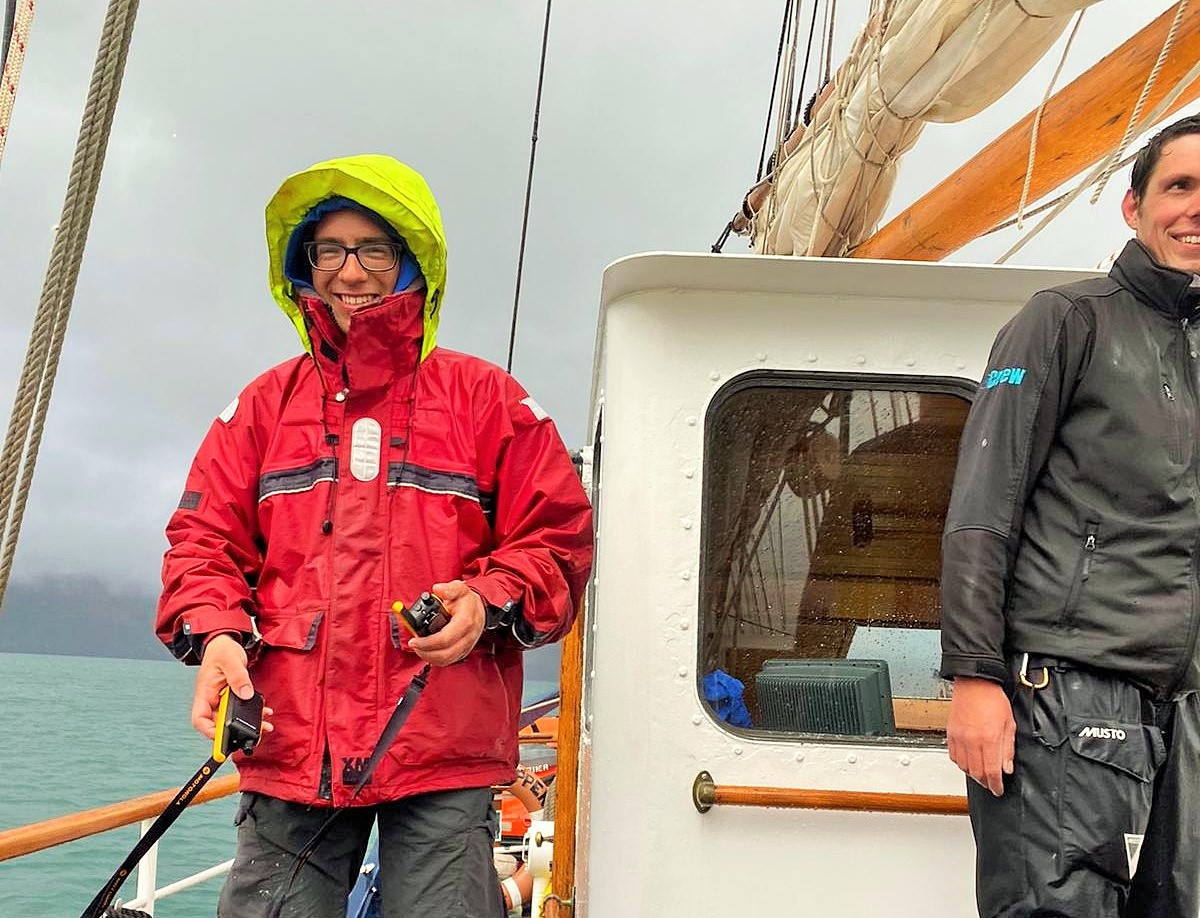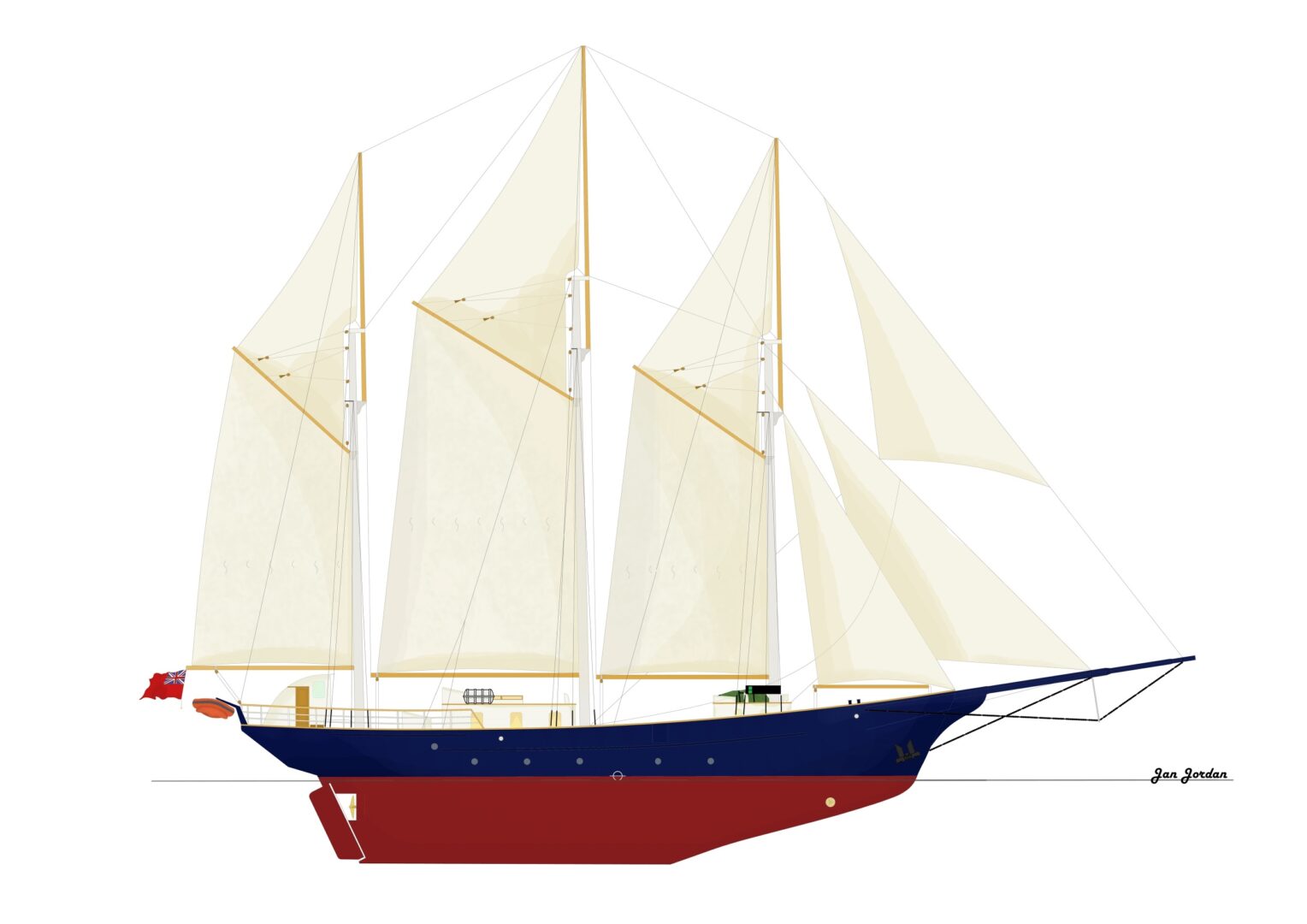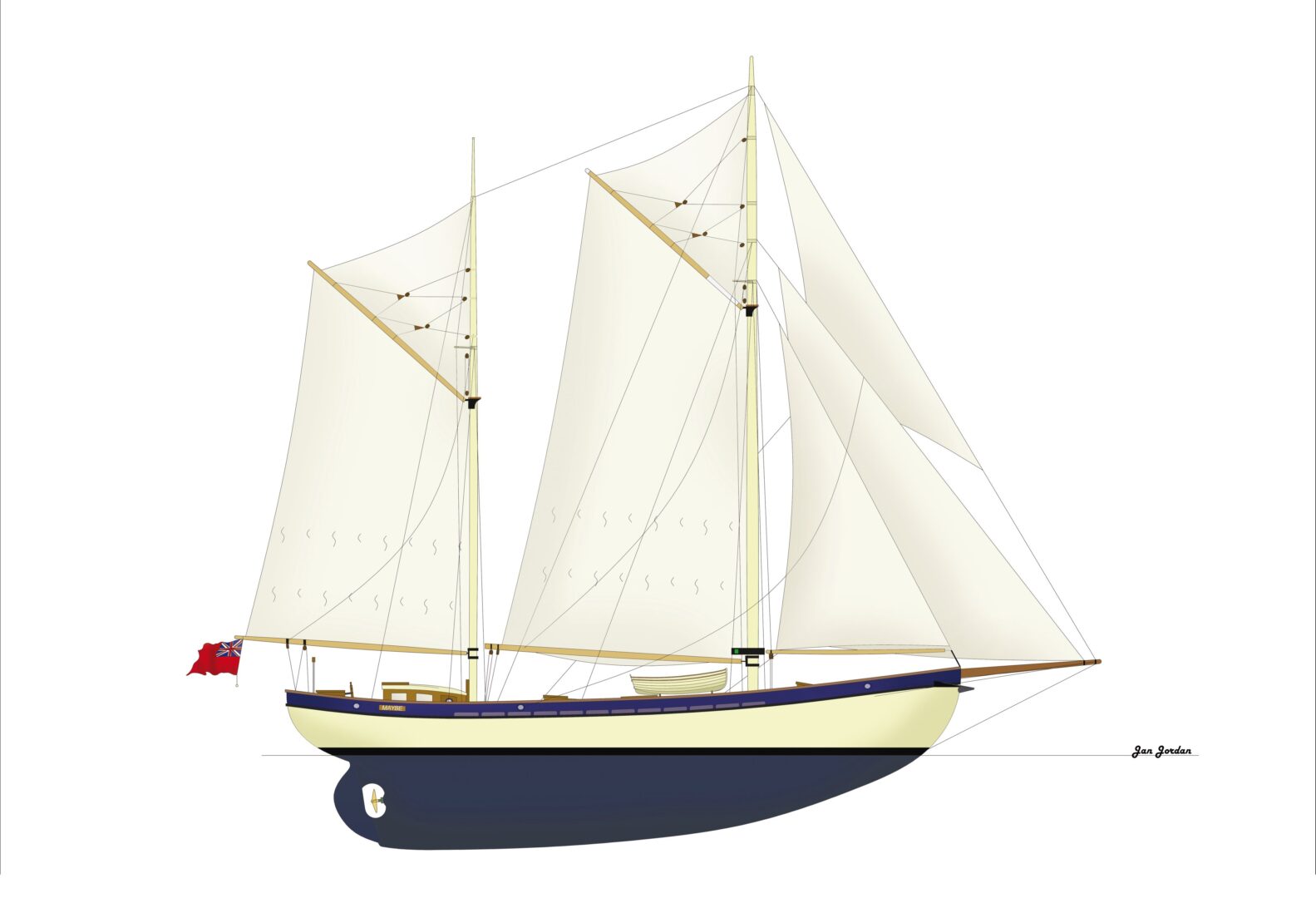
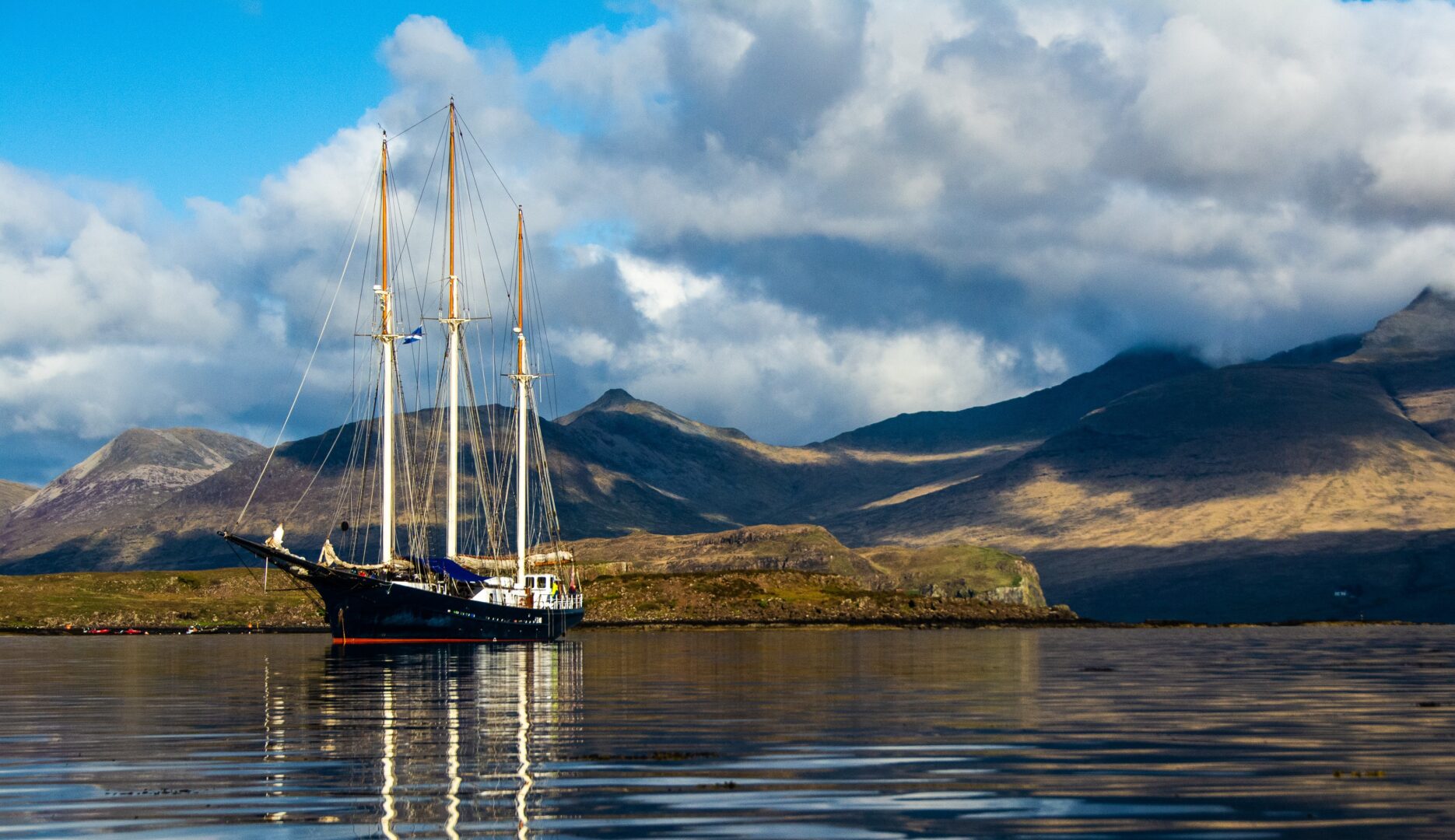
After twenty-one years living in a city, studying in classrooms surrounded by walls and, especially, after months confined to home by a global pandemic, I could hardly imagine what awaited me. I was at the end of my nautical degree, which meant that the next step was to embark as a bridge student aboard a merchant ship. However, for a long time, my ideal ship would be an indisputably beautiful vessel with masts and seals. My ideal ship was a tall ship. Against all odds, I found one where I could do my officer training. The sailboat in question was the Blue Clipper, a 45-metre-long, three-masted gaff-rigged schooner. I would also end up spending quite a bit of time aboard the Maybe, a formidable ketch from the same company.
The adventure begins
At the end of the first week of April I flew to Portimão, in the Algarve. In the middle of the afternoon I arrived at the location provided by the ship’s office, a colossal jetty located at the mouth of the Arade River, a place far away from civilisation where hundreds of ships remained at rest. At the end of the shipyard, moored to one of the piers, were two sailboats whose masts stood above the rest. As I got closer to my destination I started to see some figures busy on the deck of one of the boats, as if it were a microcosm in the middle of the desert.
The crew on board, around fifteen people between volunteers and professionals, welcomed me with open arms. It didn’t take long to realise that I would have a hard time communicating effectively enough in English (the official language on board) despite my knowledge of sailing on this type of boat. However, thank God, due to the complete forced language immersion, the situation ended up improving drastically over time. The first two months were a challenge. You can’t even imagine the pain you feel for yourself when, standing in front of a toolbox, you have to match a completely new word to a real object right in front of you.
The professionals and volunteers were under the command of Captain Grace Metcalfe. She inspired such respect and terror that even the shipowner present there did not dare to contradict her. I must say, however, that this image of Grace only describes a part of her person. Few people in my life have awakened as much admiration and respect as she has.
Heading out to sea
Before we knew it, the day had arrived. The latest weather forecast indicated that that evening was the time to set sail if we wanted to have favourable winds for the first few days of the crossing. The decision was made by the ship’s command at noon and just after dinner we were out to sea. We had more than a thousand miles ahead of us before reaching our destination, Oban, on the west coast of Scotland.
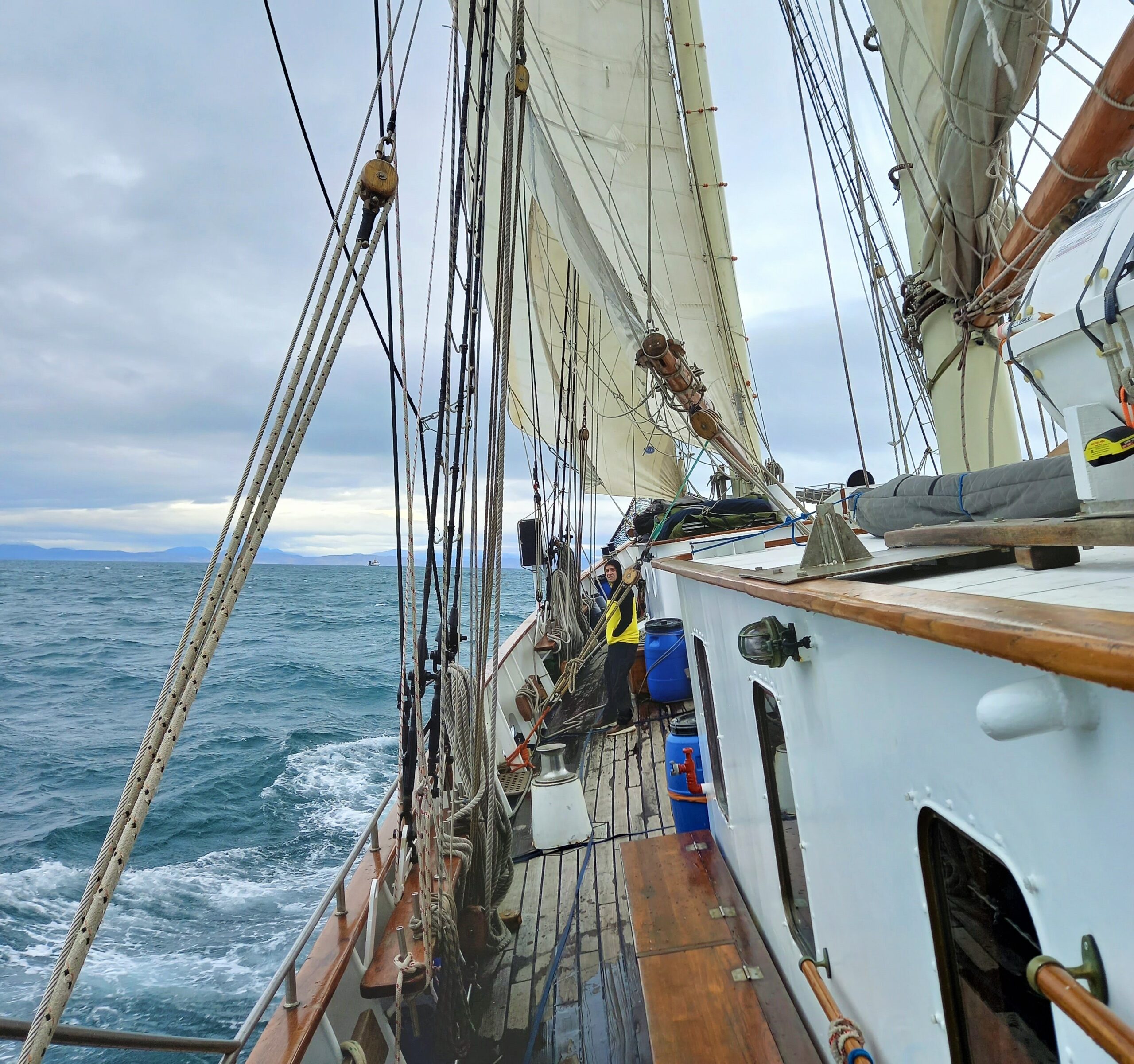
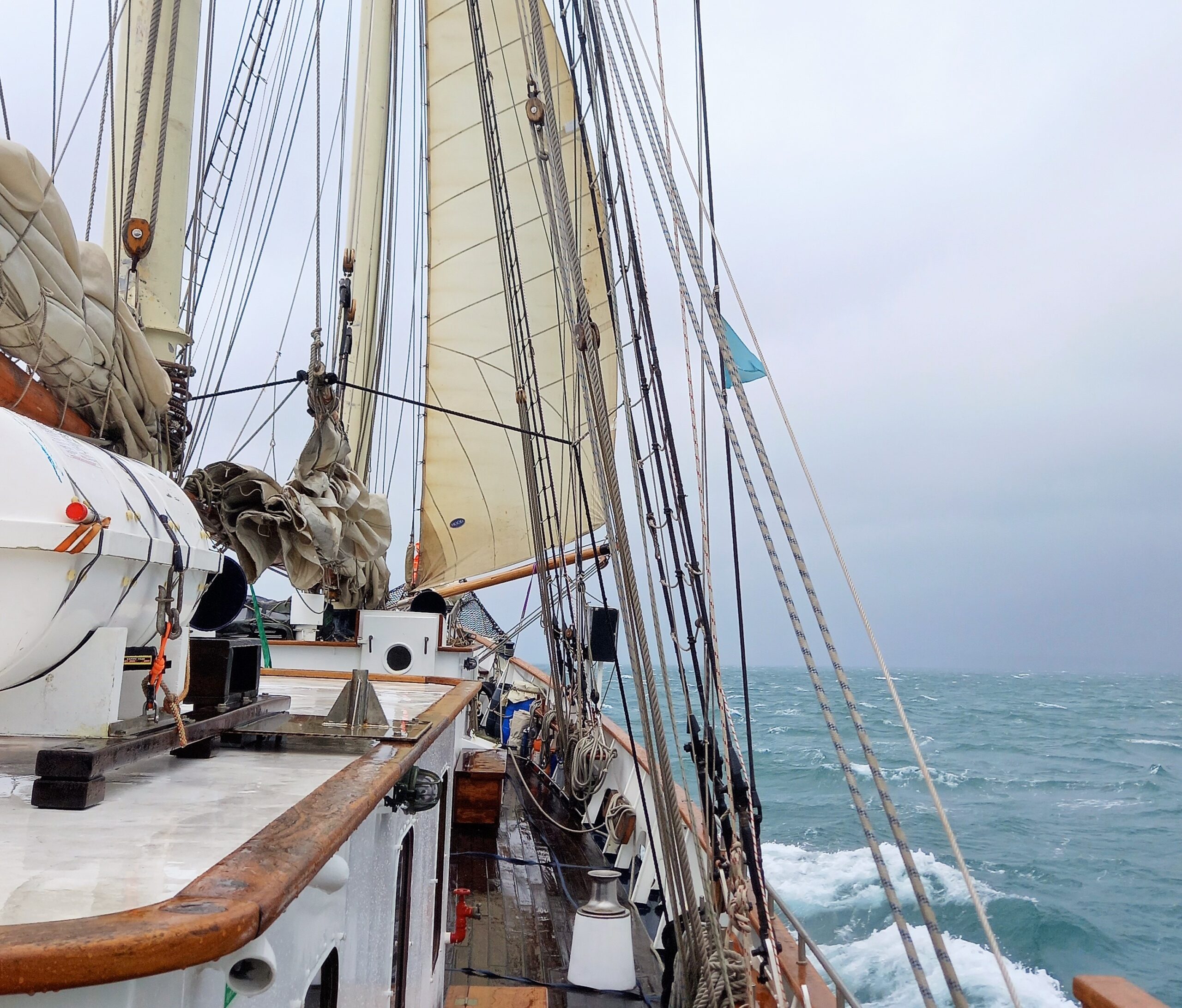
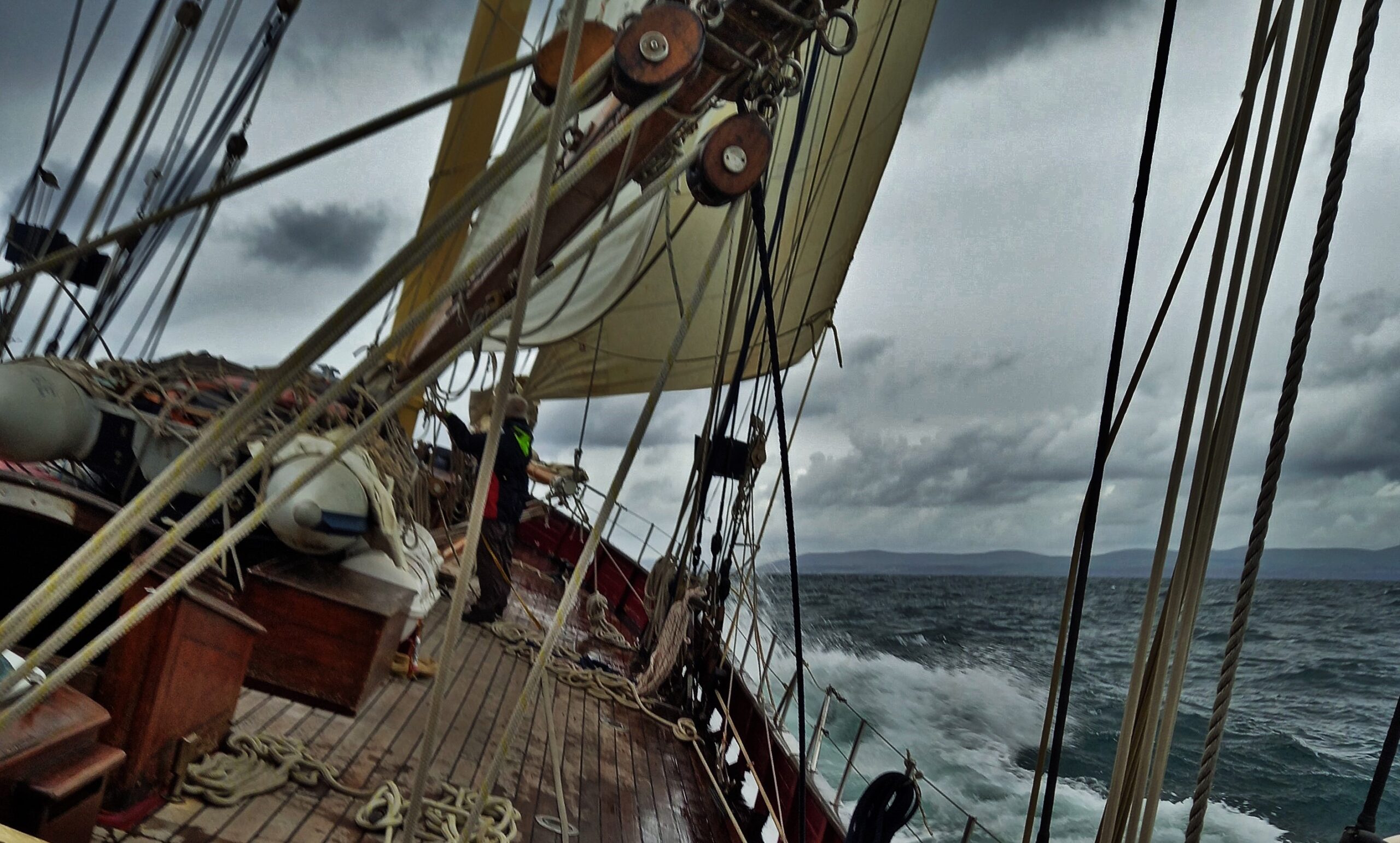
In forty-eight hours we were at Lisbon. We had spent a couple of sunny days sailing up the Portuguese coast, swaying on the deep ocean sea coming from the west. On the third day everything began to change. Little by little the wind started getting stronger while the sea began to swell. For the next six days the ship battled tirelessly against a persistent storm that propelled it at an average of 8 knots through the mighty Bay of Biscay. Waves flooded the deck one after the other, night and day. The ends of the booms dipped to the sea surface due to the ship’s sharp lists. The forecastle, where I slept with three other crew members, felt like a washing machine. In bed, my sleep was interrupted by the pounding of the quarter-tonne anchors against the hull. On the hardest days, I could count up to 3 seconds of free fall from my bunk. Waves over 5 metres high rose like impassable walls on the port side. No matter how big a ship is, there can always be waves that turn it into a walnut shell in the middle of the ocean.
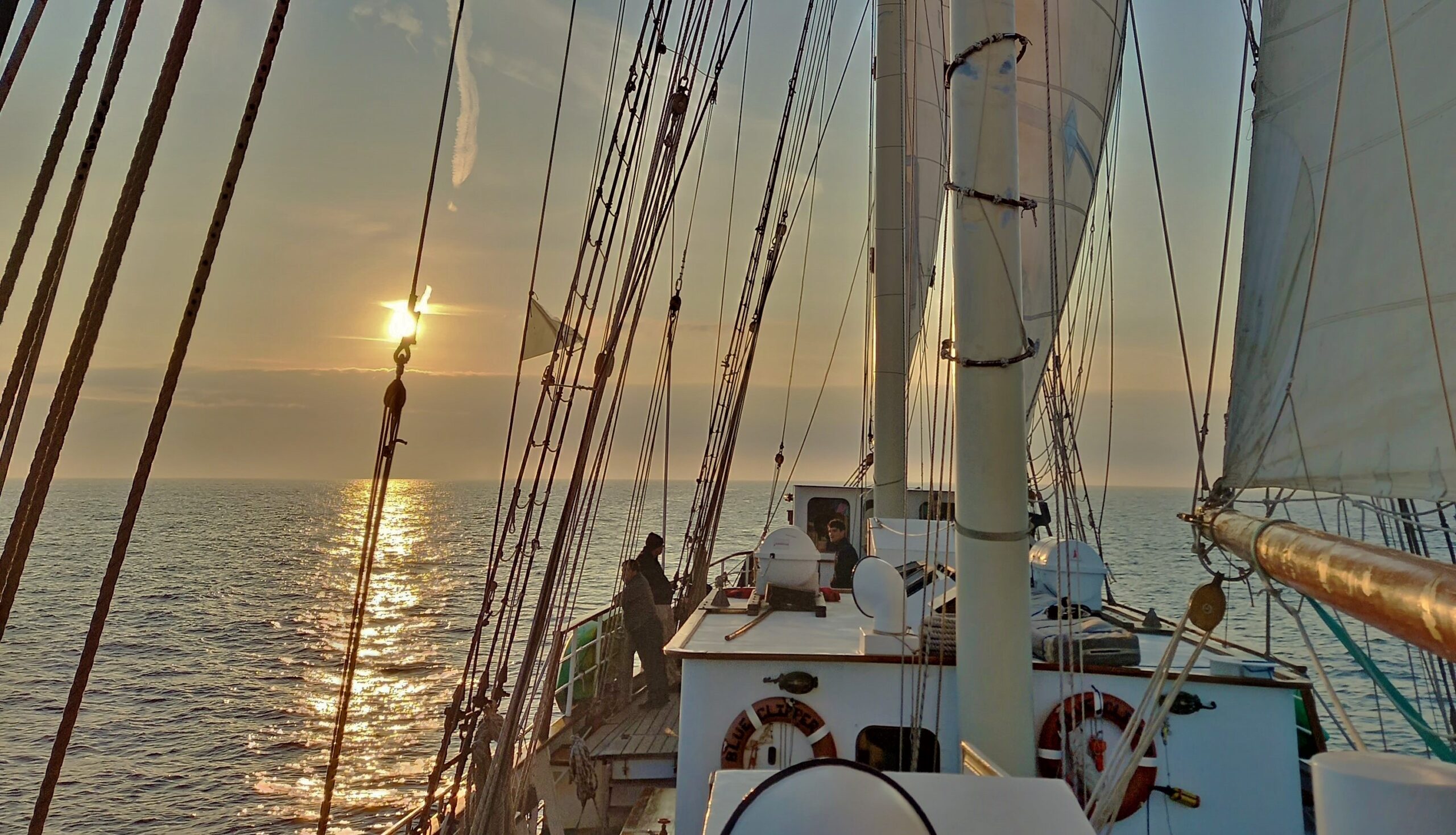
A storm doesn’t just leave you with harsh experiences, though. Seeing a 250-tonne machine riding the waves like a thoroughbred under the sole propulsion of sails is simply spectacular. The world shrunk down to the size of that boat, to her, to the Blue Clipper. At night, everything that was visible during the day disappeared. But the sun, apart from offering the opportunity to see many things, also hides others from us. In the dark, bioluminescent algae stirred by the waves illuminated the deck when it was flooded. Manoeuvring the sail at night you often found yourself splashing across a deck that felt full of bright stars. One night, from the foredeck we watched as dolphins approached. Few things have I seen in this life more beautiful and fascinating than a dolphin swimming in the dark sea illuminated by the luminous algae that react around it.
Arrival in Scotland
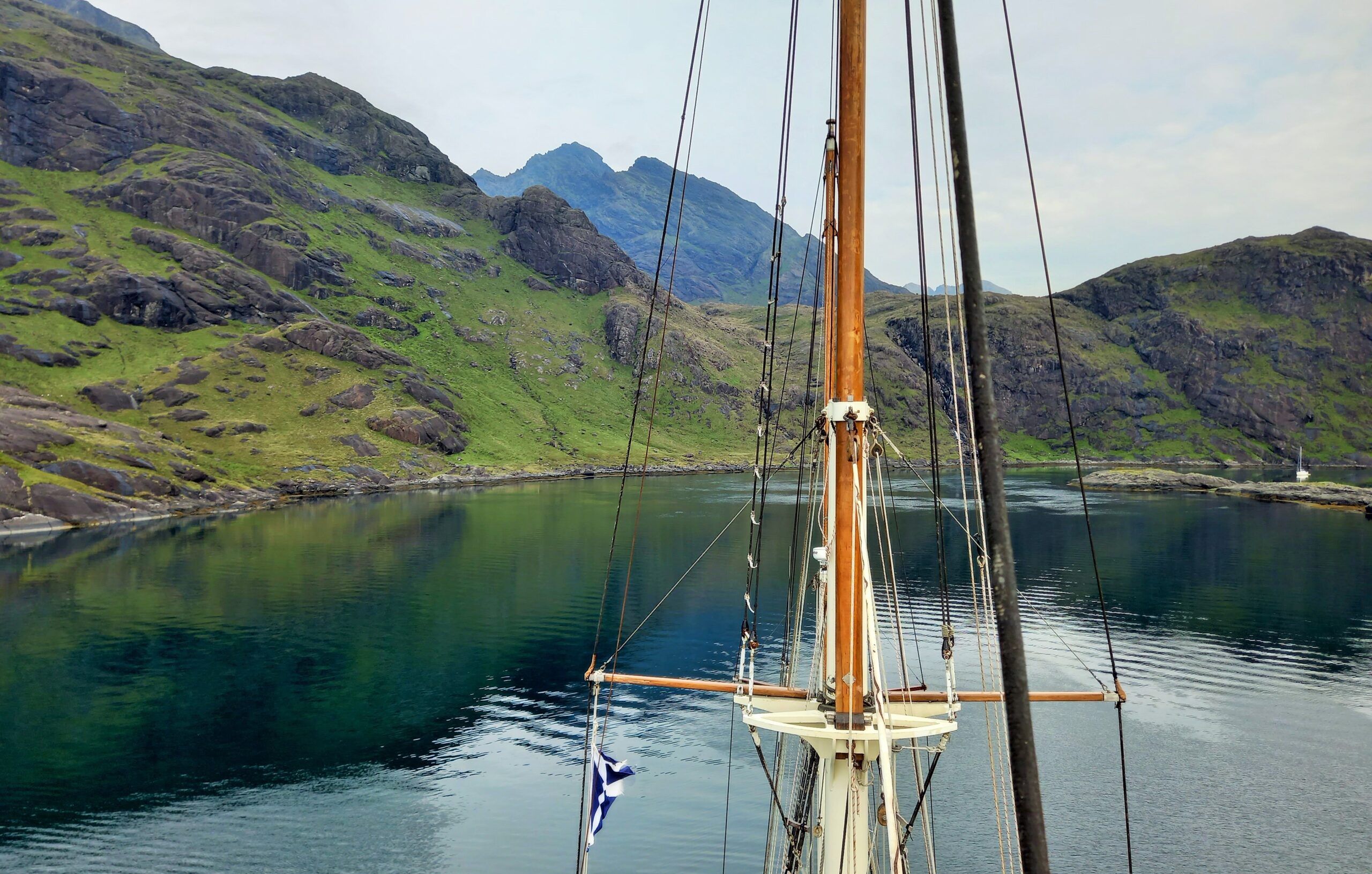
A few miles from the entrance to the Irish Sea the weather began to calm down. The last three days of the journey the sun rose and set over an oil slick. A verdant green and sunny Scotland welcomed. Meadows and forests surrounded the waters. Twelve days after leaving land we reached Oban Bay.
We spent over a month sailing week-long trips from Oban around the Isle of Mull. In June we changed base and began heading north to the small fishing town of Mallaig at the foot of the Highlands. From our new base the area of activity was no longer Mull but the so-called Sea of the Hebrides and the southern part of the Minch. These two form the stretch of water that separates the Outer Hebrides from the Inner Hebrides.
In the Sea of the Hebrides we witnessed four small, yet incredibly beautiful islands: Eigg, Rum, Canna and Muck. Although they were very close to each other, they shared almost nothing in common. Eigg is known for a self-managed community that operates in an assembly-like manner and for the caves that go deep under its volcano, now dormant. Rum is the largest of all, the entire island is covered with mountain peaks that generate deep river valleys. In one of the few urban centers there is an old mansion where decades ago great parties were held that featured exotic animals such as alligators and lions, among other nonsense. Today, walking through its gardens, if you approach the large windows you can still see the rooms just the same as when they were abandoned. Large tapestries hang from the walls and there are strange stuffed animals everywhere.
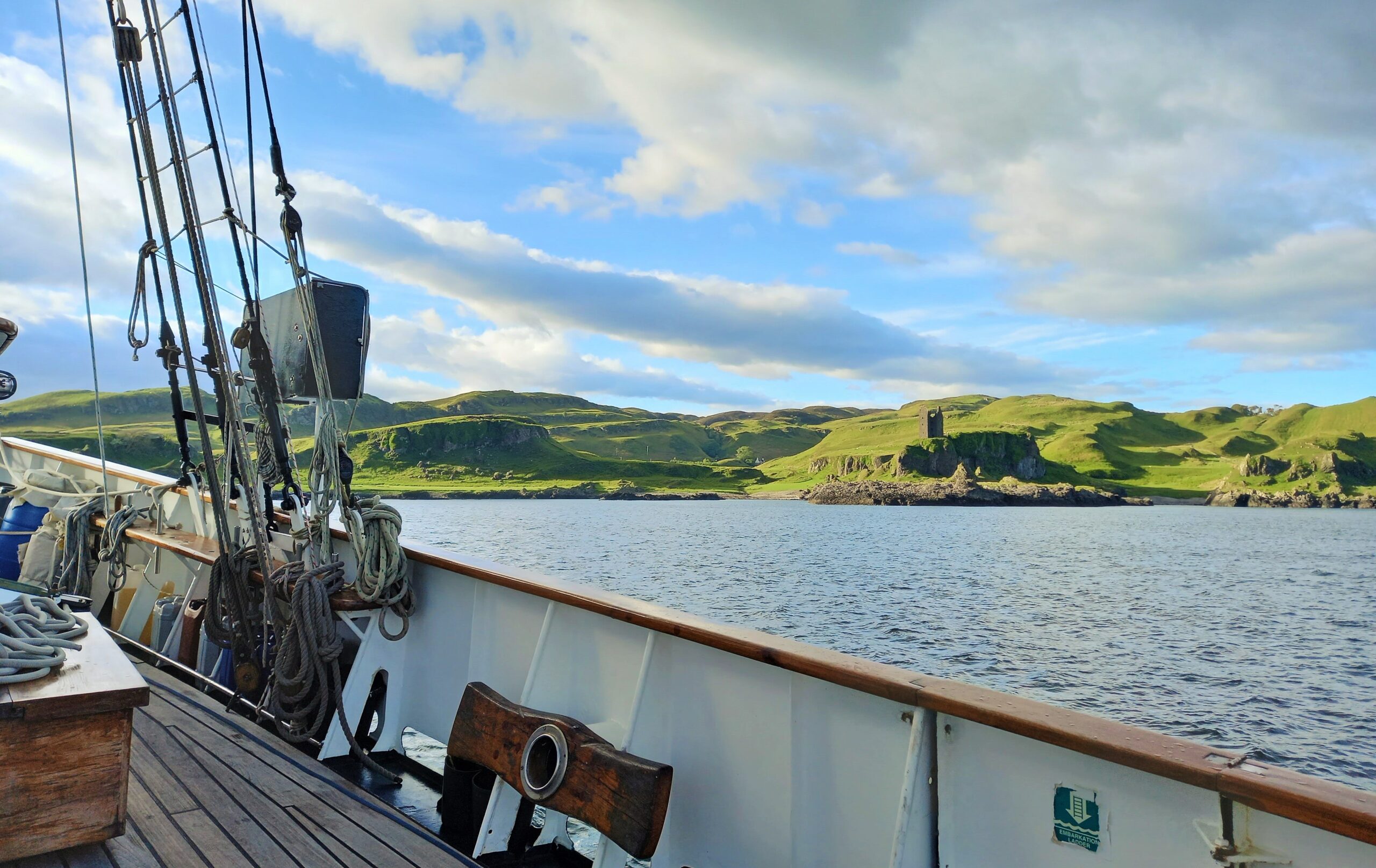
Canna is a very special place, ever since the first moment I had the opportunity to disembark there it has stolen my heart. The immense beaches of transparent waters surrounded by the eternal green of the fields take your breath away. On the island there are also a couple of ancestral hermitages that serve as social centres for the island’s few inhabitants and the ruins of a small castle hanging over the sea.
Taking advantage of the favourable winds, the Blue Clipper bore us westward to one of the most southern Outer Hebrides, Barra. The almost 700 square metres of canvas propel the boat as if it were a train locomotive, in a straight line towards the horizon until we could see Kisimul Castle in Castlebay, at sunset. What a desolate and wild land. It is no place for trees. The tallest vegetation does not exceed 50 centimetres. The wind is ever present there. The next day we used the ship’s engine to travel the few miles that separate Castlebay from Vatersay, a nearby bay. In Vatersay there is a large white sand beach in the shape of a half-moon in the distance. The water is turquoise and one could easily imagine being in the Caribbean, were it not for the freezing temperature.
Down to lower latitudes
For the next three months we sailed, making stops at Ullapool, and later the Orkney Islands, before starting to head down to lower latitudes, this time along the east coast of the British Isles. During the circumnavigation of the island, we stopped at places such as Newcastle upon Tyne, Weymouth and finally the fantastic seaside town of Falmouth in Cornwall. There, in my beloved Falmouth, we would meet up with the ketch Maybe, which I boarded in order to help the small-sized crew sail the ship to Liverpool with a group of young teenagers on board as cabin crew.
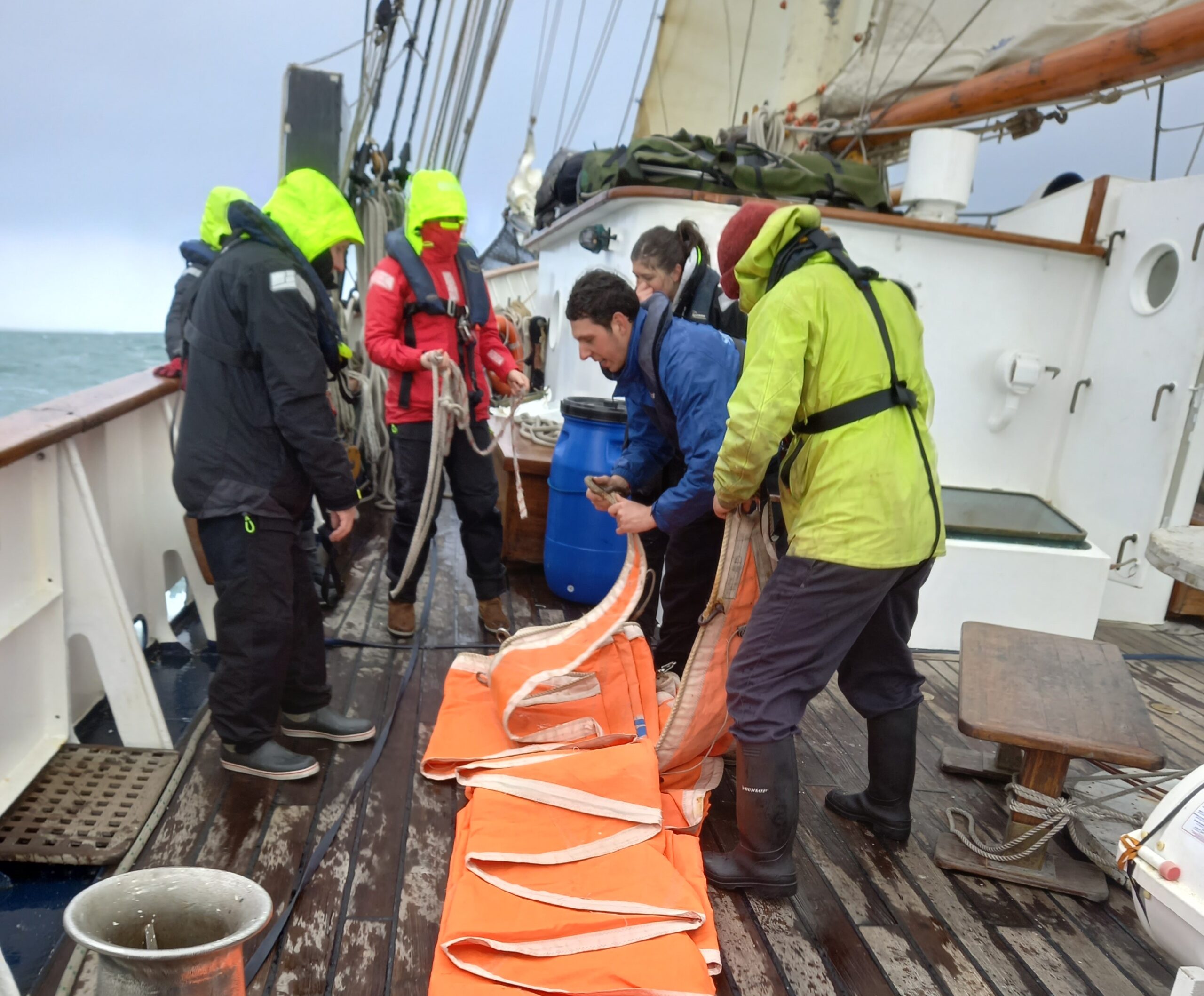
While the cabin crew help Estée prepare the deck for sailing, I cooked dinner in the hold. This would no longer be a charter boat, but rather a training ship. These young boys and girls were no longer passengers, but cabin boys and girls, and they would help take the ship across the Irish Sea to the city of Liverpool, where they came from.
After dinner, the two ships set sail for the open sea. The first twenty-four hours of sailing were placid and the sailboat glided over the waves smoothly. From then on, the weather forecast for the following days worsened. After two nights at sea where the ship’s movement continued to increase, half of the crew began to feel seasick and were knocked out of action. Despite the reduced number of hands on deck, the ship had to keep sailing. The weather maps indicated the arrival of a storm in the next forty-eight hours and, if we did not want it to catch us in the middle of the Irish Sea, we had to maintain a good speed. Our sails were the only source of propulsion on board that could keep us out of reach of the worst part of the storm, which could move us forward twice as fast as the engine.
We would have had to keep that engine running day and night, but with the sea and wind conditions, in addition to having seasick teenagers on deck, that was not a good idea. The four of us would have to steer the ship alone for the 150 miles to our destination, the Isle of Man, where we could take shelter from the storm. Each of us would have to do four-hour watches, two hours of navigation in the chart room and two hours at the helm. If no problems arose during the off-watch hours, with a bit of luck, we could catch a couple of hours of sleep. On deck the weather was mild, during that day we came across two torrential rains that hit the ship for half an hour each. During the rains the wind increased to 90 kilometres per hour, the ship listed until the leeward part of the deck was submerged. In these situations we could only change the course of the boat, fleeing the bad weather and getting it back on course once those fast curtains of water had passed.
Decisions
At midnight, when the ship was on the crest of the waves, the first lights of the Isle of Man began to appear on the horizon. If we continued in a straight line we would end up running aground on the coast. At four in the morning, when the four crew members met on deck, Captain C. Rose’s decision was made. We had to tack ahead and we had to do it without delay. With him at the wheel, Carla, Esteé and I took up positions on deck to manoeuver the 90-tonne ship. First, the mainsheet was hauled in, which took us about ten minutes due to the strength of the wind and the few hands available; then the mainmast ropes were readied and we prepared for the jib sheets. Despite being a violent tack due to the strong wind and the rocking of the ship, everything went well. With the gaff rigging already leeward, we only had to haul in the mainsheet, which would be a difficult task. The three of us sat on deck next to the gunwale. To have a point of support where we could hold our bodies in position while we pushed with our arms, each of us put our right foot against a small stanchion on the gunwale. Sitting single file with our legs spread out, one behind the other, we prepared to start hauling in that violent sheet.“Two-six!”and we pulled. After repeating it about ten times we had perhaps managed to move the sheet inch by inch. Suddenly the ship listed and the gunwale on our side was completely submerged under the water for a couple of seconds. As we sat the water covered us up to just below the chest.
The jib, still howling, was cracking wildly. We had to haul in that sheet even harder. Given our minimal success, we decided to put a handy billy on that rope and shouted another, “Two – six! “, and we pulled. This time, as it was slightly less difficult, we at least managed to stop the sail from screaming furiously. Our hands, softened by the rain and the wave that had just washed over us, were aching; after hauling in that sheet with all our strength, our skin came off as if there was nothing there.
Opening and closing those carabiners of the lifelines that kept us attached to the ship was no longer child’s play. Back at the stern of the ship, I stopped to look into the hold through a hatch. At the bottom, I found the terrified gaze of a cabin girl looking up from her bunk. Those frightened eyes made me think that, perhaps before starting my adventure that was already ending in the land of the wind, I too had had a similar look for more than a day…